
· JS · English · 13 min read
Balcony Solar in Stuttgart: Technology, Safety and Yield
What applies to plug-in balcony solar systems in Stuttgart: power limits, grid registration, mounting, connectors, storage, yield and when a rooftop PV system makes more sense.
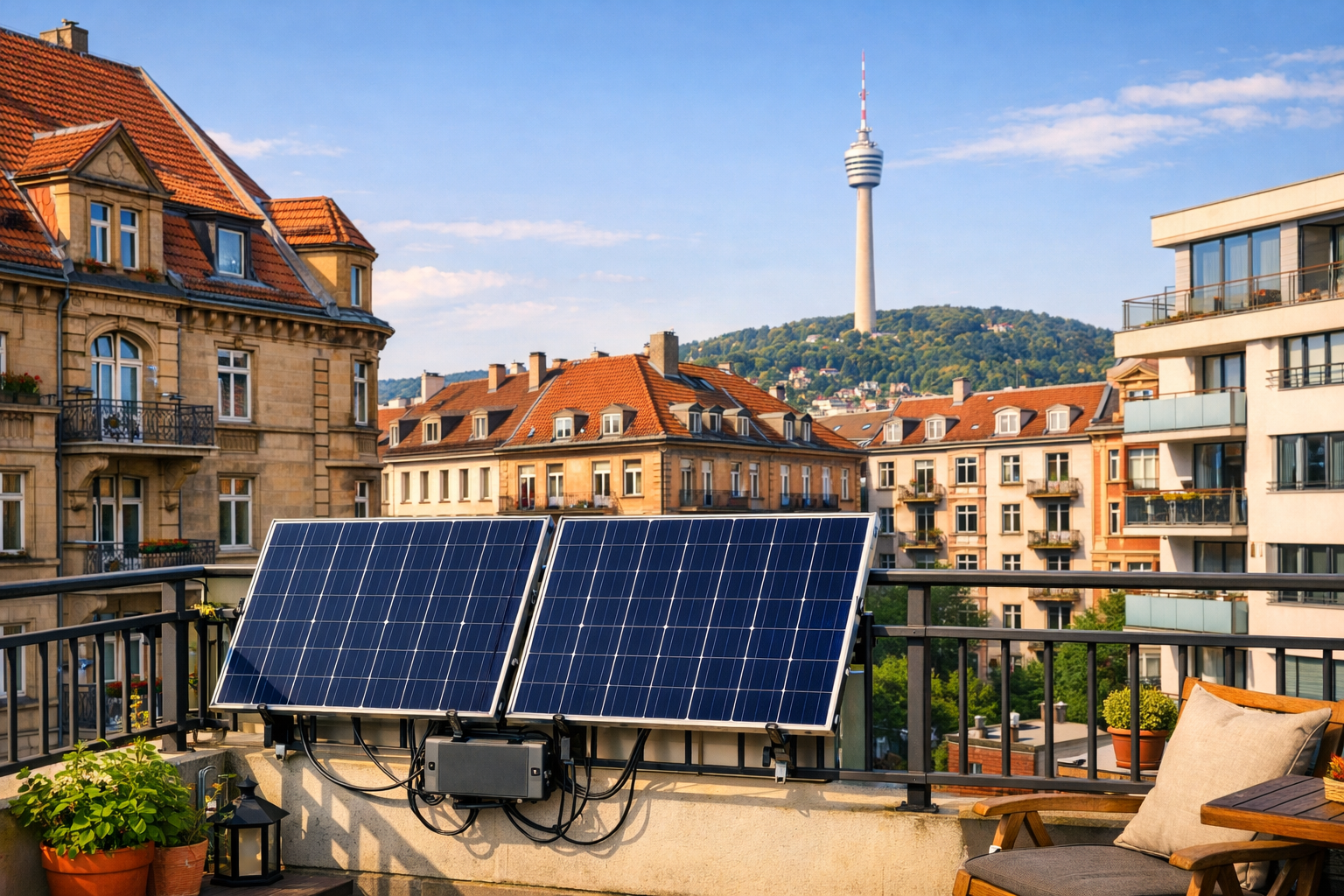
Many people in Stuttgart are looking for a simple solar solution for a balcony, terrace or small secondary surface. Especially in the city centre, there is often no private roof area, no easy route to approving a larger PV system, or too much shading on the building roof. A balcony solar system can then be a useful entry point: compact, comparatively affordable and focused on your own electricity consumption.
This article explains what matters technically and organisationally in Stuttgart: power limits, registration, meters, connectors, mechanical mounting, storage and yield.
As of: June 2026.
What is a balcony solar system?
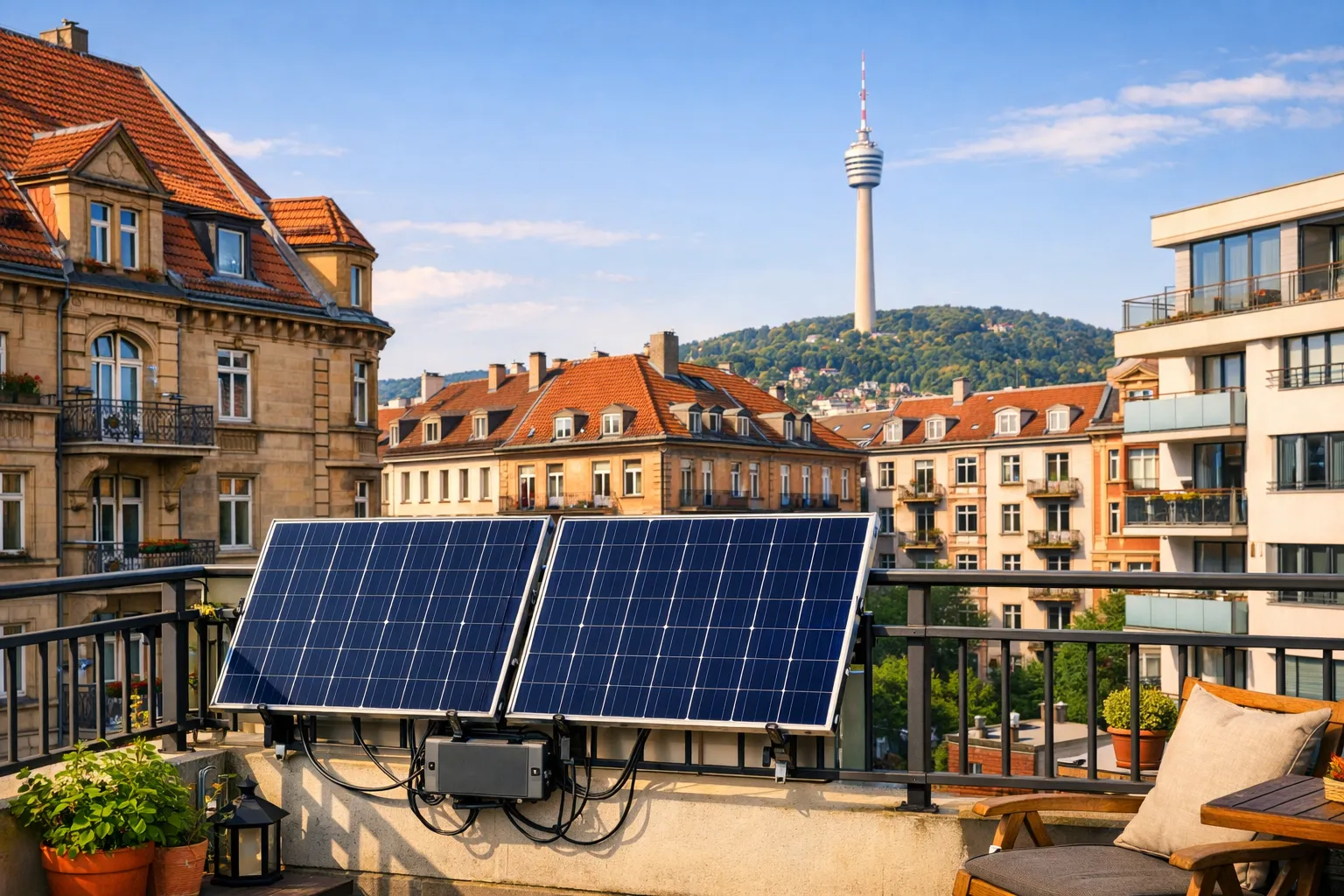
The more precise German technical term is Steckersolargeraet, meaning a plug-in solar device or plug-in PV system. It is a small photovoltaic system, typically consisting of one or more PV modules, DC cabling, a microinverter, an AC connection cable and a connection to the household or apartment circuit.
The PV modules generate direct current (DC). The microinverter converts it into alternating current (AC). This electricity is used first in the household, for example by the fridge, router, standby loads, home-office equipment, washing machine or chargers. Energy that is not used flows into the public grid unless technical zero-export control is implemented.
Balcony solar systems are especially interesting for rented apartments, owner-occupied apartments, balconies, terraces, garages and small secondary areas. They do not replace a full rooftop PV system, but they can cover part of the base load and make solar power possible where a larger system is not realistic.
What power is allowed?
For the simplified EEG and grid-operator process in Germany, two limits are central: up to 2 kWp installed module power on the DC side and up to 800 VA inverter apparent power on the AC side [2]. In everyday language this is often called 800 watts, but the technically relevant value is the maximum inverter apparent power in VA.
For devices with adjustable power, the Bundesnetzagentur states that the relevant value is not the selected operating mode, but the highest selectable installed power or inverter power [2].
The special rules for plug-in solar devices also require the system to be assigned to the German EEG marketing category unentgeltliche Abnahme, meaning unremunerated acceptance. No feed-in tariff is paid for electricity exported from the device [2]. For balcony solar systems, self-consumption should therefore be the main focus.
The 2 kWp limit refers to the statutory limit for plug-in solar devices under the simplified EEG process [2]. The often-mentioned 960 Wp comes from the product standard DIN VDE V 0126-95:2025-12 for plug-in solar devices with a household plug [6].
Combined PV-and-storage devices with up to 2,000 Wp PV input power and 800 VA AC output may also be possible without a special energy socket if the device concept, manufacturer approval and grid-side certificates are suitable. A useful check is whether the grid-connected generation unit has a ZEREZ-ID. ZEREZ lists certificates and evidence documents, not the private balcony system itself [7].
Registration, MaStR and meters in Stuttgart
For Stuttgart, the Stuttgart Netze page on plug-in PV systems is the most important local source. According to Stuttgart Netze, no separate registration with the grid operator is required if no feed-in tariff is claimed and the system stays within the limits of up to 2 kW installed power and up to 800 VA inverter power [1].
In these cases, registration is only required in the German Market Master Data Register (MaStR) [1], [12]. This includes personal data, system location, technical data, commissioning date and meter number. According to Stuttgart Netze, the meter number should be entered in the MaStR field Identifikationsnummer des Netzbetreibers [1].
Stuttgart Netze also states that a bidirectional meter will be replaced or installed free of charge as part of the planned rollout of modern metering technology. If the power limits are exceeded or a feed-in tariff is requested, the system leaves the simplified process. A regular PV system process involving a qualified electrician is then required [1].

Safety: what should you check before buying and mounting?
Balcony solar systems are often marketed as simple plug-and-play products. In practice, it is worth taking a closer look. Even if the power is small, the system is still electrical equipment intended for continuous outdoor operation. Mechanical mounting, connectors and manufacturer documentation are therefore not minor details.
Electrical connection
The existing final circuit and protective devices must be suitable for the system. Multi-socket strips, chains of extension leads or improvised plug connections are not suitable. Stuttgart Netze recommends contacting a registered electrician before installation. The operator and connection user remain responsible for connection and operation [1].
At minimum, the manufacturer documentation and relevant evidence should be checked. Without claiming to be complete, this includes:
CEmarking, while noting that CE is not an independent test mark- product standard for plug-in solar devices:
DIN VDE V 0126-95 - inverter / grid connection: evidence according to
VDE-AR-N 4105, unit certificate, NA protection and ideally a findableZEREZ-ID - PV modules: certificates according to
IEC 61215andIEC 61730, often with test marks from VDE, TUV, Intertek or comparable test institutes - PV connectors: testing according to
IEC 62852or manufacturer approval for the exact connector pairing - PV cables: UV- and weather-resistant cables suitable for PV applications, for example according to
EN 50618/ typeH1Z2Z2-K - inverter and connection cable: suitable outdoor protection rating, for example
IP65or higher depending on the installation location
Mechanical mounting
Mechanical mounting is often underestimated. Wind load, fall protection, railing, facade, mounting angle and shading must fit the actual situation. Balcony railings, solid walls, clinker, wood, concrete and insulated facades are mechanically very different cases.
If screws, anchors or plugs are not included with the mounting kit, that is not necessarily a mistake. The fixing material must match the substrate. Especially with external thermal insulation composite systems or insulated facades, simply drilling in any plug can be dangerous. Possible consequences include pull-out, water ingress, thermal bridges, facade damage or, in the worst case, falling modules. If in doubt, clarify the facade build-up and ask the mounting-system manufacturer, an anchor manufacturer such as Fischer or a qualified specialist. Suitable fixing material can cost more than the balcony mounting frame itself.
For rented apartments or condominiums, approval from the landlord or owners’ association should be obtained in advance. Since 17 October 2024, plug-in solar devices are privileged under German tenancy and condominium law: installation may not be refused across the board. However, the type, location and safe execution can still be specified or decided. The legal basis is Section 554(1) BGB for rented apartments and Section 20(2) No. 5 WEG for owners’ associations [3], [4].
Solar connectors and “MC4-compatible”
PV connectors deserve particular care. In everyday language, “MC4” is often used as a generic term. What matters is not whether two connectors somehow fit mechanically, but whether that exact pairing has been tested and approved by the manufacturer.
No-name connectors, adapters and mixed connectors from different manufacturers are critical if there is no reliable approval for the pairing. Incorrectly paired, poorly crimped or disconnected-under-load DC connectors can cause increased contact resistance, heating and electric arcs. If “standard MC4” is advertised but the delivered connectors cannot be clearly identified, the connection should not be assembled by feel. DC connectors should also not be disconnected under load.
Why Solarzentrum Stuttgart does not install balcony solar systems
As a specialist company, we carry a different responsibility than private individuals, retailers or pure DIY providers. Private individuals can generally install and operate a suitable, standards-compliant plug-in solar device themselves if the requirements are met and they follow the user manual and manufacturer instructions.
For us as a specialist company, that standard is not sufficient. We would have to professionally assess the socket or circuit, mechanical mounting, fall safety, connectors, manufacturer documentation, liability and warranty. For installations above public traffic areas or in safety-relevant areas, we may also only use modules with the required suitability or approval for that installation context.
The effort for inspection, documentation and liability is too high compared with the small system size. For both sides, we cannot offer balcony solar systems economically in a sensible way. This is not criticism of balcony solar systems. It is an honest explanation of why they do not fit our service model. In fact, we are happy when balcony solar systems are implemented safely in Stuttgart.
For the same reason, we cannot advise on specific individual cases, product approvals, facade mounting, connector pairings or the selection of individual balcony solar kits. The concrete check must be based on manufacturer documents, a qualified electrician, the building owner and, for mounting questions, suitable specialist advice.
Who can help in Stuttgart?
For private individuals, the SolarScouts in Stuttgart can be a helpful point of contact [13]. They support people on a voluntary basis with initial orientation and general questions about the process. Here too, voluntary advice does not replace an electrical inspection, professional installation or concrete product selection for a safety-relevant individual case.
What does a balcony solar system achieve?
A balcony solar system mainly reduces grid consumption during sunny hours. Because no feed-in tariff is paid under the simplified process for plug-in solar devices, the directly self-consumed solar electricity is what matters economically.
For yield and cost estimates, the HTW Berlin plug-in solar simulator, its calculation documentation, the German Environment Agency and PVGIS by the European Commission are good starting points [8], [9], [10] and [11]. The HTW simulator includes PV power, inverter power, storage size, household demand, orientation, tilt, shading, investment costs and electricity price [9], [10].
A balcony solar system is especially useful in central Stuttgart if there is no private or reasonably usable roof area, if a south-, east- or west-facing orientation with little shading is possible, or if there is measurable daytime base load. Shading from neighbouring buildings, balcony railings, trees or balconies above can significantly reduce yield.
Storage and night-time consumption
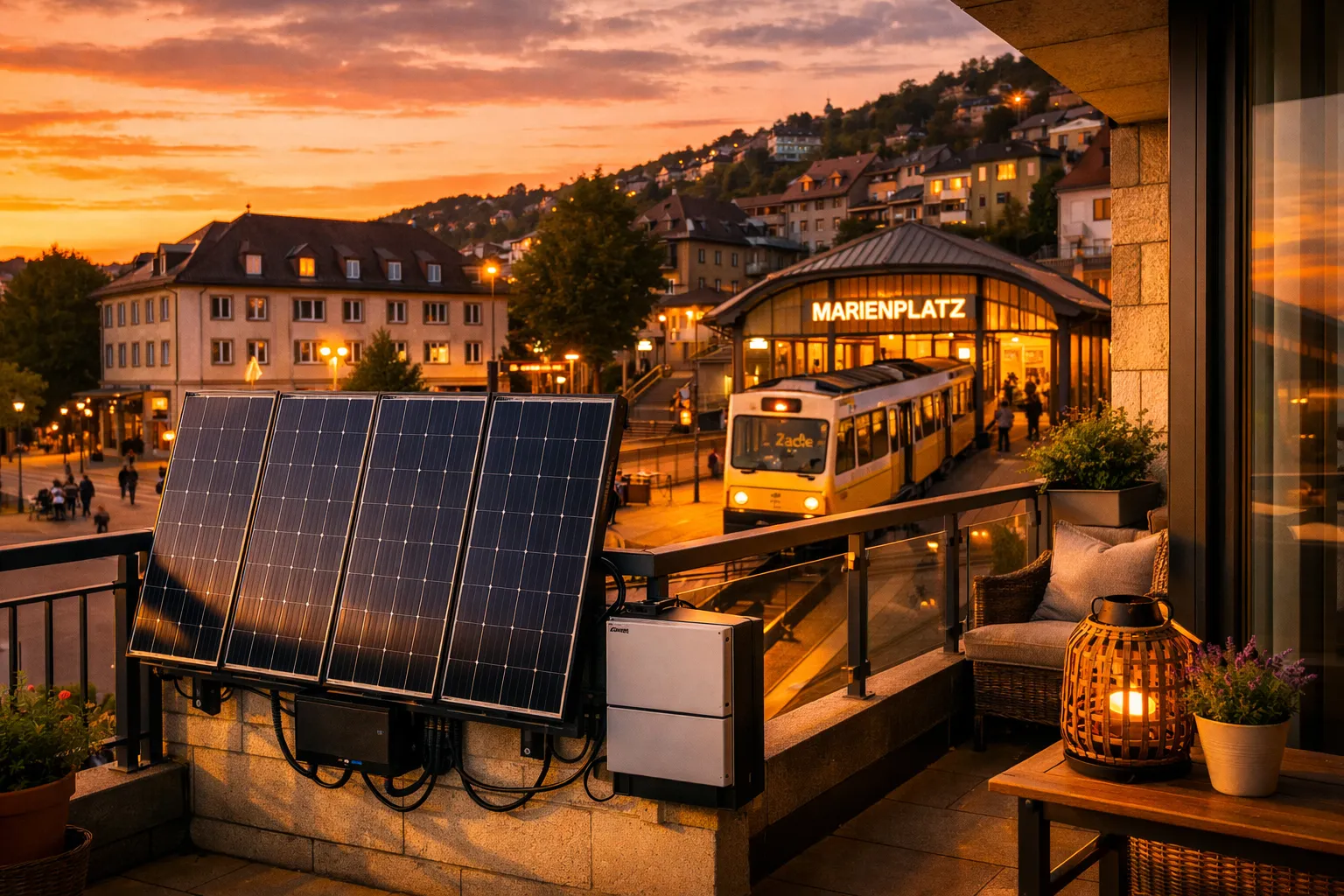
A small storage system of roughly 1 to 3 kWh makes sense if surplus is regularly produced during the day and there is measurable evening or night-time consumption. This mainly applies to the summer half-year. In winter, PV yield is much lower; an oversized battery will often not be fully charged and will add little economic benefit.
For an initial sizing estimate, note the meter reading for two weeks in summer: in the morning as the last person leaving the house, in the afternoon as the first person returning, and in the evening before going to bed. These values help estimate actual base load, daytime load and evening/night consumption. They should be compared with the planned 2 kWp module power, expected daily yield and usable battery capacity. The battery should not be much larger than the regularly usable surplus plus evening/night consumption.
The 800 VA limit remains relevant with storage. A battery can only partly cover high-power loads, for example a kettle, a cooking plate or other appliances whose power exceeds the output limit. Storage should therefore not be recommended or dismissed across the board. It becomes economically interesting mainly when it is correctly sized, cycled regularly and replaces expensive grid electricity.
When does a rooftop PV system make more sense?
A rooftop system is the better path when a private or long-term usable roof area is available. Further requirements are a suitable roof, sufficient structural capacity, a suitable or modernisable electrical distribution system and clarified ownership conditions.
A rooftop PV system becomes especially attractive with higher annual electricity consumption or planned loads such as a heat pump, electric car, air conditioning, battery storage or even commercial use. Compared with a balcony solar system, it offers much higher generator power, more relevant annual yield, the possibility of regular feed-in remuneration and better scalability for storage, wallbox and heat pump.
A balcony solar system and a larger PV system do not fundamentally exclude each other. What matters is which surface is available, which loads exist and whether the electrical and legal situation can be clarified properly.
Quick decision guide
A balcony solar system tends to fit apartments, balconies, terraces, small garage roofs, limited space, inner-city situations without suitable roof area and a realistic focus on self-consumption from small power levels.
A rooftop PV system tends to fit detached houses, apartment buildings or commercial properties with sufficient unshaded roof area, higher electricity demand and a long-term investment perspective.
If the balcony idea might actually become a proper rooftop PV project, Solarzentrum Stuttgart can check the options for PV installation in Stuttgart or discuss next steps via contact.
Frequently asked questions
Do I have to register a balcony solar system in Stuttgart?
Under the simplified process, Stuttgart Netze states that no separate registration with the grid operator is required if the power limits are met and no feed-in tariff is claimed. Registration in the Market Master Data Register remains required [1], [12].
What do 800 VA, 960 Wp and 2 kWp mean?800 VA describes the maximum inverter apparent power on the AC side. 2 kWp is the statutory limit for plug-in solar devices under the simplified EEG process [2]. 960 Wp comes from the product standard for plug-in solar devices with a household plug [6].
What does 2 kWp module power mean in practice?2 kWp module power roughly corresponds to the installed peak power of the PV modules under standard test conditions. In practice, that is often about four “normal” PV modules with around 500 Wp each, as commonly used on rooftops and roughly 1 m x 2 m in size. Alternatively, it can be three larger modules with about 660 Wp each, more typical for large solar parks, with roughly 1 m x 2.3 m dimensions.
What does 800 VA apparent power mean in everyday terms?800 VA is not a lot of household power. It is the AC output limit that the balcony solar system or storage system may supply at the same time. In everyday terms, it is clearly below the typical power of many heating appliances. A kettle is often well above 1,500 W, frequently around 2,000 W or more. Hair dryers and single cooking plates are also usually clearly above 800 W in normal use. 800 VA is closer to a powerful desktop or gaming PC under load, or several small continuous loads combined.
Is a balcony solar system with storage worth it?
That depends strongly on self-consumption, summer yield, storage size and battery cost. Small batteries can be useful if surplus is regularly produced during the day and there is evening or night-time demand.
Why does Solarzentrum Stuttgart not install balcony solar systems?
Because as a specialist company we would have to assess socket, circuit, mounting, connectors, manufacturer documents, liability and warranty. For small plug-in solar devices, that effort cannot be offered economically in a sensible way.
Sources
[1] Stuttgart Netze GmbH, “Steckerfertige PV-Anlagen,” Stuttgart Netze. Accessed: 26 June 2026.
[2] Bundesnetzagentur, “Balkon-Solaranlagen,” Bundesnetzagentur. Accessed: 26 June 2026.
[3] Federal Ministry of Justice, “Section 554 BGB: Barrier reduction, e-mobility, burglary protection and plug-in solar devices,” Gesetze im Internet. Accessed: 26 June 2026.
[4] Federal Ministry of Justice, “Section 20 WEG: Structural alterations,” Gesetze im Internet. Accessed: 26 June 2026.
[5] VDE FNN, “Steckerfertige PV-Anlagen,” VDE. Accessed: 26 June 2026.
[6] VDE/DKE, “DKE veröffentlicht weltweit erste Produktnorm für Steckersolargeräte,” VDE, 2025. Accessed: 26 June 2026.
[7] ZEREZ, “Zentrales Register für Einheiten- und Komponentenzertifikate,” ZEREZ. Accessed: 26 June 2026.
[8] German Environment Agency, “Steckersolargeräte / Balkonkraftwerke,” Umweltbundesamt. Accessed: 26 June 2026.
[9] University of Applied Sciences Berlin, “Stecker-Solar-Simulator,” HTW Berlin. Accessed: 26 June 2026.
[10] L. Orth, “Stecker-Solar-Simulator: Dokumentation der Berechnungsgrundlagen,” University of Applied Sciences Berlin, 2024. Accessed: 26 June 2026.
[11] European Commission, Joint Research Centre, “PVGIS Photovoltaic Geographical Information System,” European Commission. Accessed: 26 June 2026.
[12] Bundesnetzagentur, “Marktstammdatenregister,” Market Master Data Register. Accessed: 26 June 2026.
[13] SolarScouts Stuttgart, “Stuttgarter SolarScouts,” SolarScouts Stuttgart. Accessed: 26 June 2026.