

Buy or rent our EL & PL inspection equipment
Perform EL and PL inspections yourself under any operating conditions with our patented DaySy inspection technology.
Equipment > Cameras
Select a suitable EL and PL camera for your specific use-case.
HR 246
High-Resolution 24.6 MP NightSy-Cam
- Most Indoor/outdoor applications
- Not suitable for direct sunlight
- High Resolution 24.6 MP CMOS sensor
- Ideal for post-shipment inspection
HS 53
High-Sensitivity 5.3 MP DaySy-Cam
- Any Indoor/Outdoor application
- Suitable for direct sunlight
- High Sensitivity 5.3 MP InGaAs sensor
- Ideal for post installation/disaster inspection
HS 13
High-Sensitivity 1.3 MP DaySy-Cam
- Any Indoor/Outdoor application
- Suitable for direct sunlight
- High Sensitivity 1.3 MP InGaAs sensor
- Budget friendly allrounder
Operating Range - Ambient Light
The operating range below shows the brightness level of the surrounding environment at which the cameras are expected to perform. All cameras use our patented DaySy lock-in technology which enables the operation in full daylight. Only the DaySy-Cam's with InGaAs sensor will deliver good results in direct sunlight, while the NightSy-Cam's are preferred for low irradiation environments like indoors.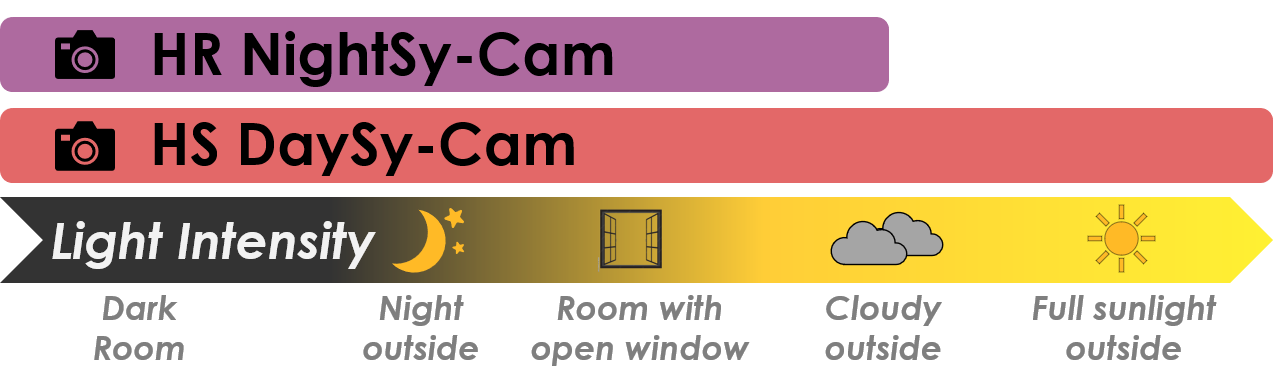
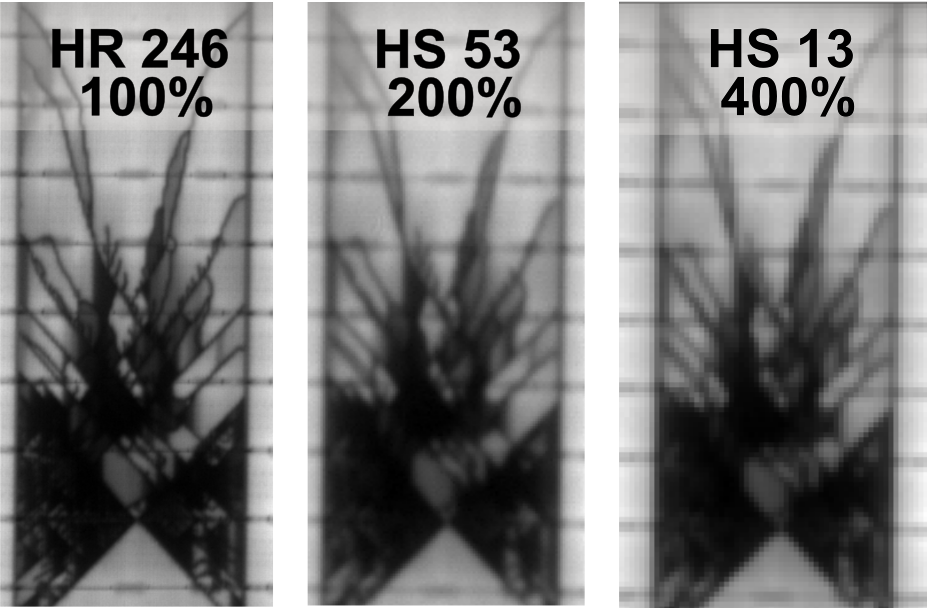
Resolution comparison using an example image
The electroluminescence image below shows a Trina module (Trina Vertex S TSM-400DE09.08) with several different defects. EL images of this module were taken from the shown perspective with each camera.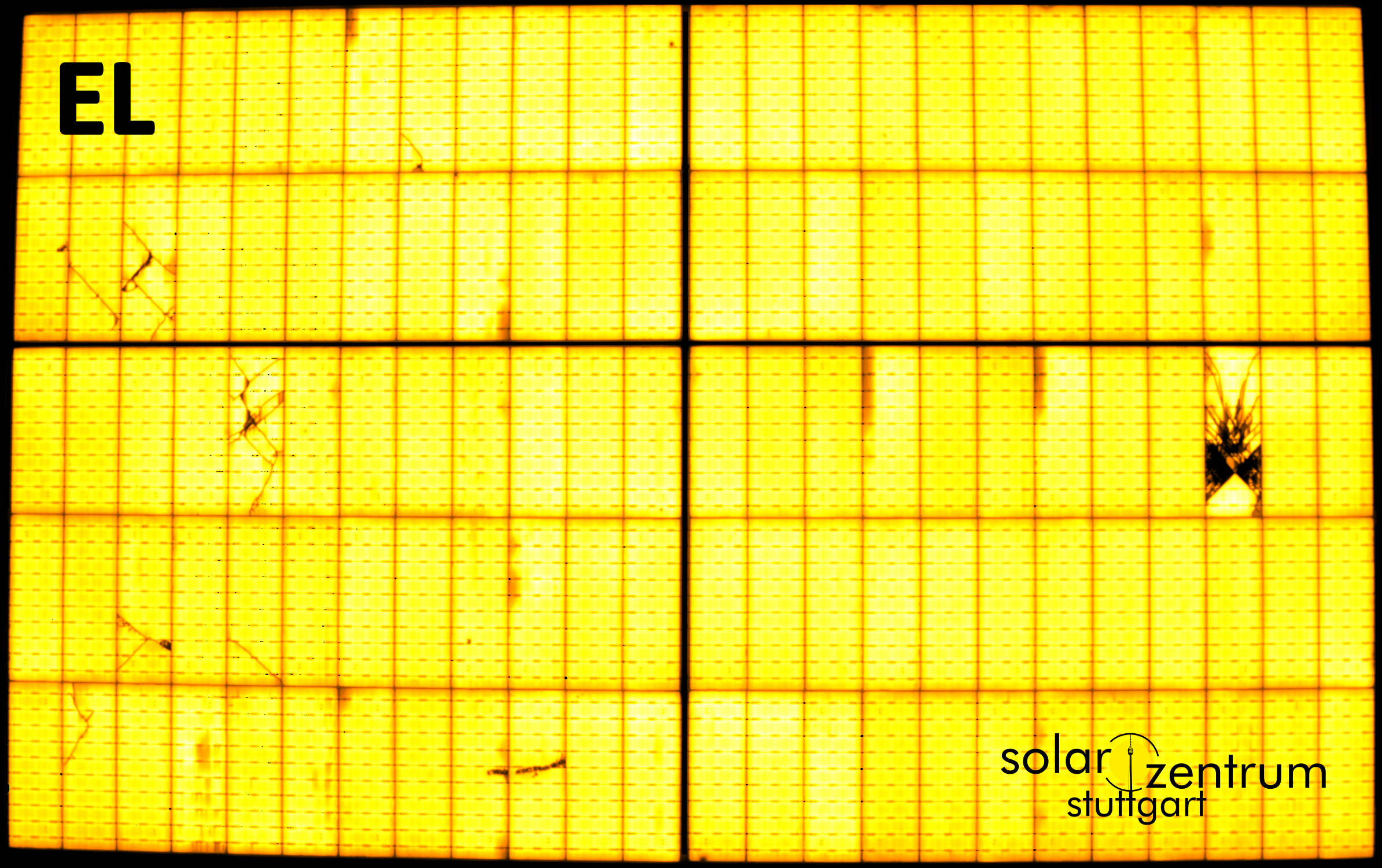
Resolution on a 1.80 m module
The following values show the approximate imaging scale on a classic PV module with a length of 1.80 m.
| Camera resolution | Pixel size on module | Spatial resolution |
|---|---|---|
| 24 MP | 0.4 mm/pixel | approx. 1.5 lp/mm |
| 5 MP | 0.75 mm/pixel | approx. 0.7 lp/mm |
| 1 MP | 1.5 mm/pixel | approx. 0.35 lp/mm |
What does this mean in practice?
Dark areas and millimeter-scale defects can generally be detected with all cameras. The higher pixel count becomes important when the cause needs to be distinguished more precisely: are we looking at two closely spaced cracks, one larger connected defect, or possibly only dirt on the glass? The higher the resolution, the more robustly this distinction can be made in the EL image.
For detecting the defect classes listed in the VDE catalog, the HS 13 is usually sufficient. One exception is very small V-/X-cracks (tiny V/X-cracks) below 4 mm.
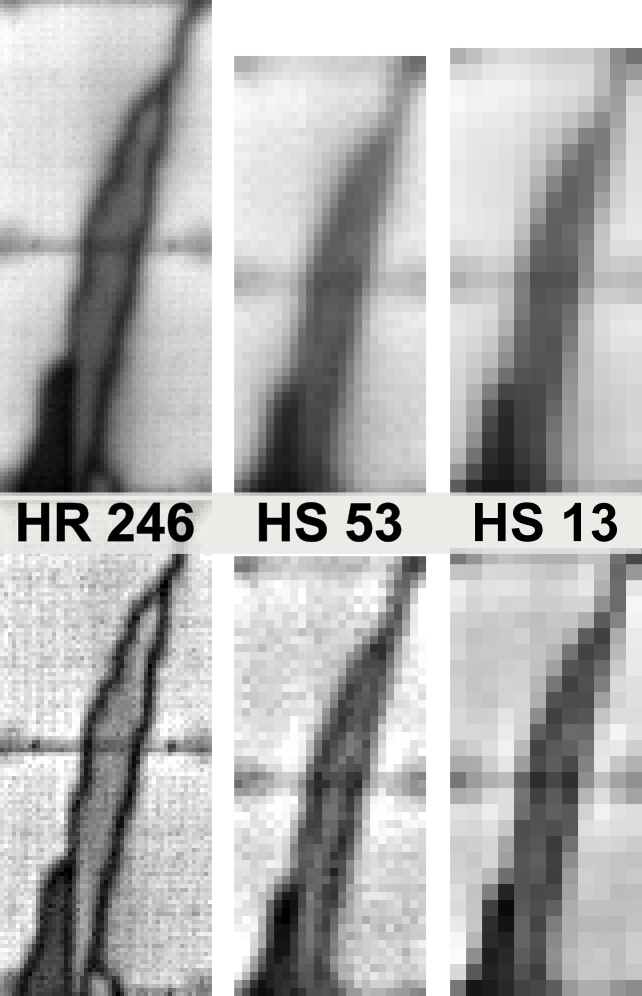
For illustration, the following figure shows a crop of two cracks in the upper cell with the respective scaling. The top row is unprocessed and the bottom row has been sharpened. The busbar spacing is 1.2 cm, and the crack separation is 3-4 mm. Therefore the HS 53 camera is adequate to inspect tiny X-/V-shaped cracks larger than 3mm. For defect patterns where an even smaller scale is relevant a HR 246 camera would be required.
USAF 1951 resolution target in the EL image
The EL image shows a cracked solar cell with a clearly visible branching crack pattern. To demonstrate the image resolution, Group −1 of a USAF 1951 resolution target was added to the close-up view. Since the structures of this group can still be resolved, the imaging system achieves a practical detail resolution in the millimetre range. This makes it possible to reliably visualize not only large cell fractures, but also fine crack branches and electrically relevant crack structures.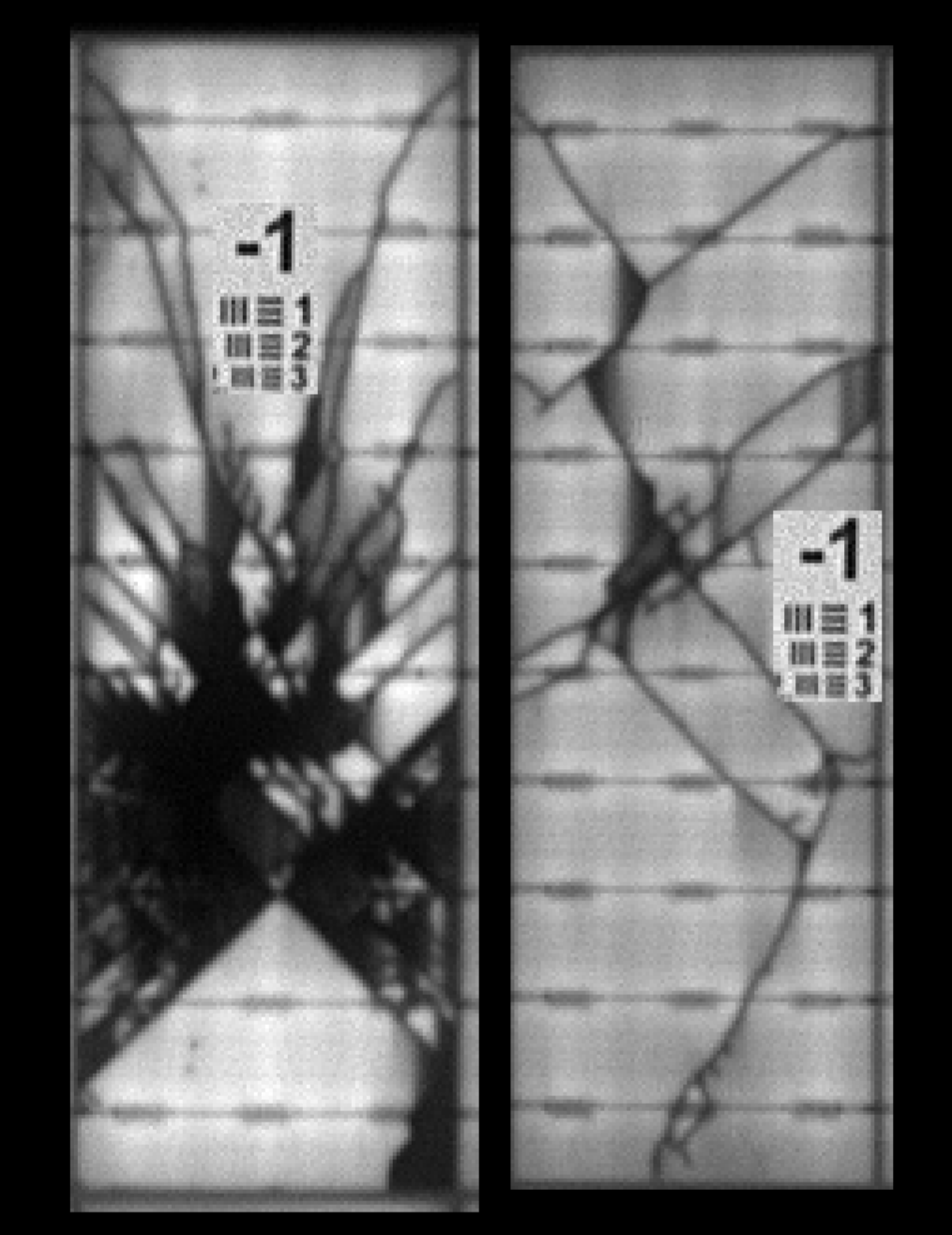
Applications
MEL: Module EL inspection
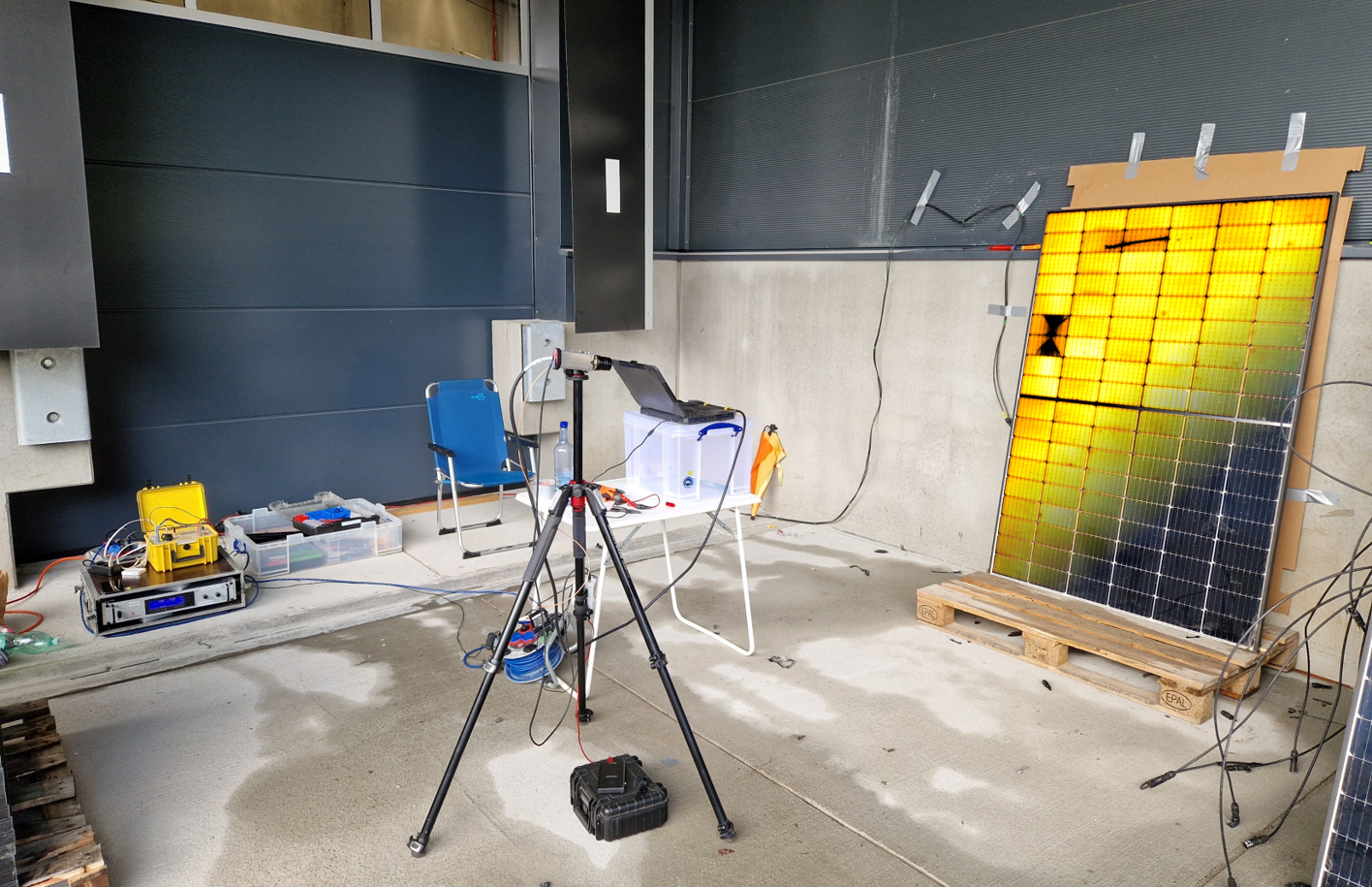
Inspect one single PV module at a time.Post-shipment inspection
Easily ensure that your PV modules meet all necessary specifications and quality standards upon arrival. Care for bankability and traceability of the project. Inspect samples after delivery in a warehouse or on site for damage and cracks possibly caused during transport.
Easy setup even at daylight
Our DaySy Equipment allows you to inspect PV modules without the need for complicated setups during the day. Place the camera on a tripod and you are good to go: any time indoors or outdoors.
High throughput of 480 modules per day
Within 8 working hours you can inspect up to 480 modules. Each high-resolution EL image is stamped with the serial number of the PV module.
PL Upgrade
With the MEL-PL upgrade you inspect installed PV modules one by one without the need of an additional electrical power source.
Recommended Setup
Camera: HR 246,
Package: MEL package,
Accessoires: PSU MEL, Laptop, Barcode Scanner Tripod
SEL: String EL inspection
Power a full PV string at once to quickly inspect each module.Post installation / disaster inspection
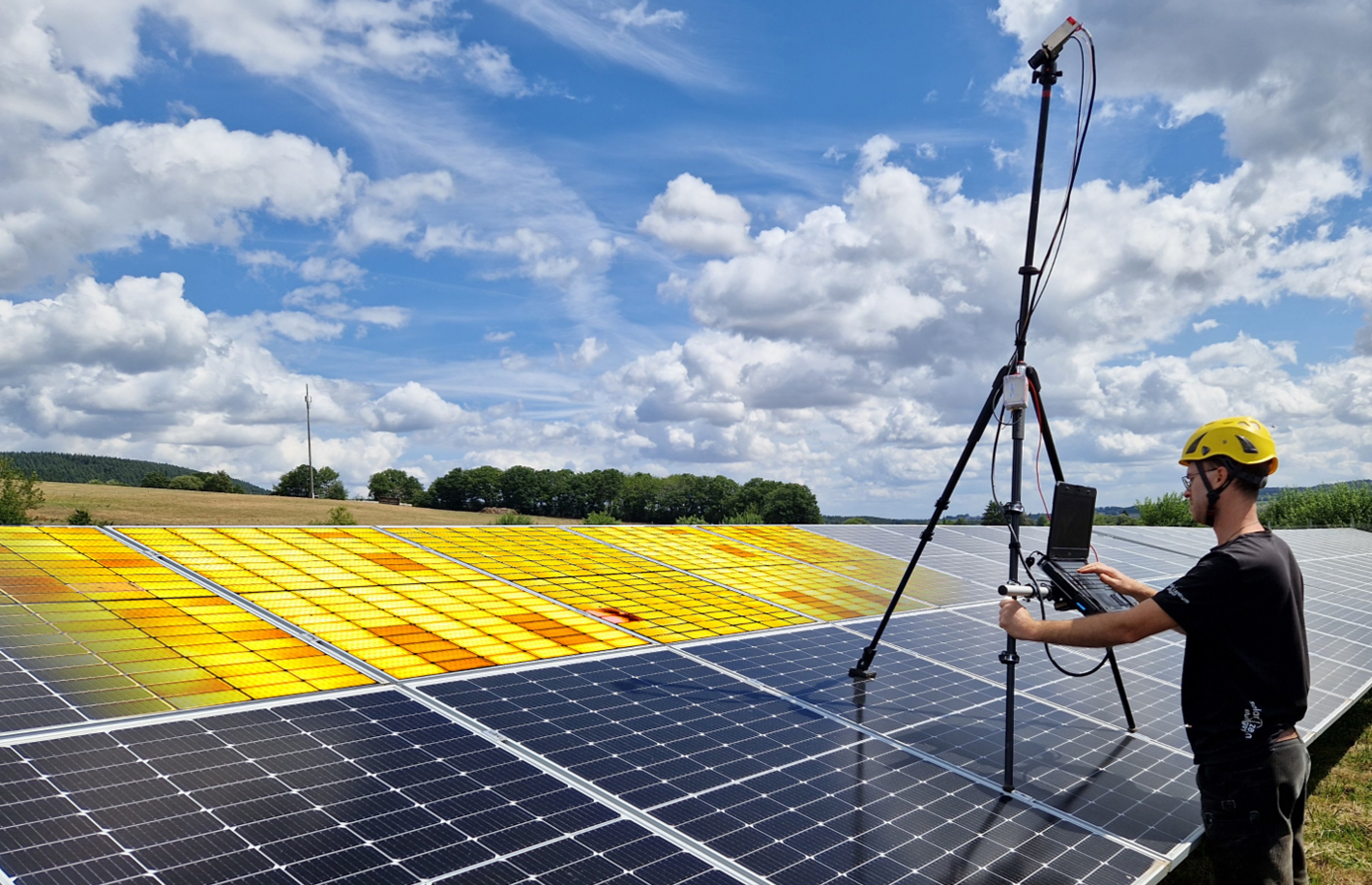
Our patented DaySy process allows luminescence inspections of PV modules in their installed state in full daylight. Disassembly of the modules or complex setups and containers are simply outdated.
EL a whole PV String at once!
The electrical power source energises the entire PV string while the camera moves from module to module to generate high resolution images. A barcode may be attached as well.
High throughput of 1200 modules per day
Within 8 working hours you can inspect up to 1200 modules. While inspecting, you create high-resolution EL images of each PV module, which provide information about the degree of damage and its cause.
PL Upgrade
The SEL-PL Upgrade energises a full PV string without the need of an additional electrical power source.
Recommended Setup
Camera: HS 53,
Package: SEL package,
Accessoires: PSU SEL, Laptop, Tripod
Interested?
Please contact us if you are interested.
We will be happy to advise you!